Category Archives: Oral Care

The Side Effects of Veneers

Dental veneers are a thin coating of ceramic

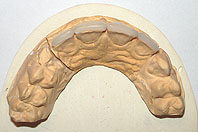
Dental veneers are a thin coating of ceramic that is placed over the tooth on the outer side of the tooth. The placement of veneers on your teeth will give you a brighter smile and improve the appearance of your teeth. The cosmetic treatment consists of thin, customized, tooth-colored shells that qualified dentists bond to the outer surface of teeth. Dental veneers can correct problems related to the color, length, size and shape of teeth when properly constructed and attached. Continue reading
Advantages and Disadvantages of Dental Bridges

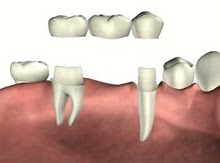
© meinersdentistry.com

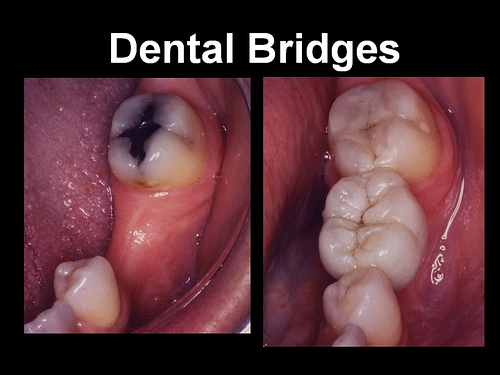
A dental bridge, or also known as a fixed partial denture, is a dental restoration that fills in the gap between teeth by replacing the missing tooth with a prosthetic one made out of metal or porcelain which is then anchored permanently to the adjacent healthy teeth. There are several types of fixed tooth bridges including conventional dental bridges, cantilever bridge and resin-bonded (adhesive) bridge. Continue reading

Questions and Answers :Flexible Dentures

credits to dentalartslab.com

What are flexible dentures?

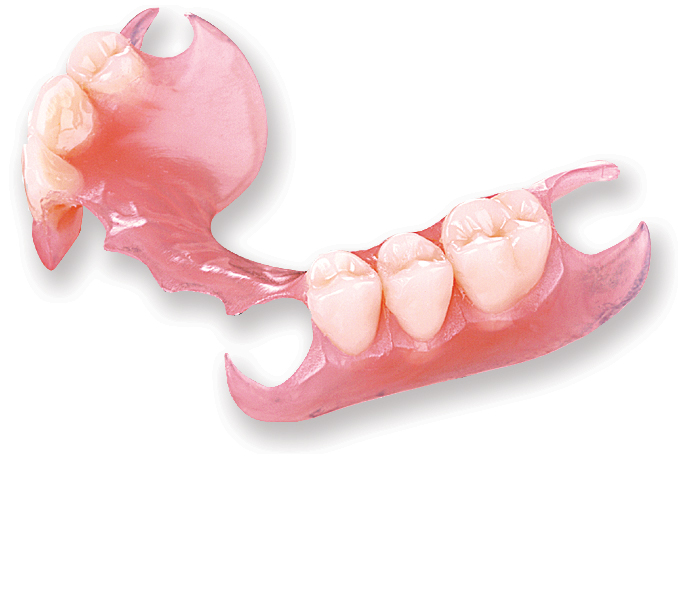
Normal acrylic dentures are hard, rigid and can fracture when they are dropped accidentally. Flexible dentures are introduced by Valplast Company (during 1950s) and as their name suggest, they are flexible in nature.  Continue reading

The Safety of an MRI for Dental Implants

Dental implants can pose difficulties for an individual having an MRI (magnetic resonance imaging), but do not automatically rule out undergoing the procedure, according to Frank G. Shellock, PhD. Shellock has studied the safety and biological effects of magnetic resonance imaging for 25 years and has identified several areas of concern for those with dental implants. Continue reading

Dental Partial Vs. Bridges


Before we discuss about the advantages between dental partial dentures and dental bridges let me explain briefly about them.

Removable partial denture is a prosthesis to replace missing teeth which can be easily removed and placed in the mouth by the patient.

Fixed partial denture, in other words dental bridge is used to replace missing tooth which is support by adjacent teeth or implant and cannot be removed  by the patient.

Each of them has its own advantages and disadvantages and normally your dental surgeon will choose the best option to replace your missing teeth based on your oral condition. Continue reading

Tips for Extraction of Baby Teeth

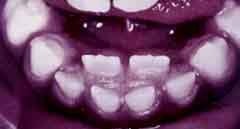
The permanent tooth is displaced because the milk teeth is not extracted in time

All people at some point in their lives will need to have their baby teeth extracted. The primary reason for extracting these teeth is to make room for permanent teeth. Other reasons for extraction are to prevent the crowding of teeth in the mouth, circumvent tooth decay or prevent injury to the inside of the jaw. No matter which of these scenarios describes your circumstances, there are a number of ways to safely extract baby teeth. Continue reading

The Ingredients in Freedent Gum

Freedent, the first non-stick chewing gum, was introduced by the Wrigley Company in 1975. Freedent was developed for those who can’t chew regular gum due to dentures and dental work. As of 2010, Freedent is available in Canada, the U.S., France and New Zealand. Wrigley’s Freedent gum comes in peppermint and spearmint. The ingredients of both flavors are nearly identical; the only difference is the peppermint or spearmint oil used for flavoring. Continue reading

The Ozone Treatment for Cavities

HealOzone instrument - for sterilizing infected tooth

Can ozone be used to treat caries (cavities) without the need for drilling and filling? It seems that ozone therapy in dentistry is coming of age. If one of your teeth has only small areas of decay, we can often use ozone treatment to sterilise it. Bacteria that causes tooth decay is found deep within the tooth structure. Removing these bacteria would usually mean amputating the infected area of the tooth (and there’s always the risk that infected areas could be left behind). A further concern would be that the fillings put into the tooth are not a permanent solution, on average they last between 6 months and a couple of years. Each time the filling is replaced, the filling has to be larger and more of the tooth is damaged. This downward spiral usually leads to expensive dental reconstruction. Continue reading

The Effects of Bleach on Skin

Bleach is a solution of a compound called sodium hypochlorite; sometimes calcium hypochlorite is called bleach as well. Both compounds dissolve readily in water and are highly alkaline. The Material Safety Data Sheet for Clorox regular bleach, for example, lists the pH of its product as 11.9. Chlorine bleach (a solution of approximately 3–6% sodium hypochlorite, NaClO) and ammonia, when used together, can have very harmful effects on the body. It is especially important to avoid exposing the skin or eyes to bleach when handling it, as such an exposure can cause severe tissue damage. Continue reading

The Disadvantages of Porcelain Crowns

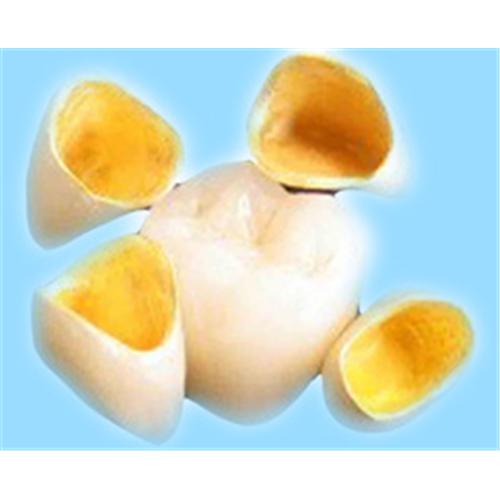
A porcelain crown

Teeth can become weak due to extensive damage to the teeth, or certain dental procedures, or worn from age or neglect. When this happens your dentist can fit a crown, which will protect the tooth against future damage for up to 20 years. Crowns then are ‘covers’ for our teeth that fit over the chewing surface and over and around the outside surfaces like a glove. This can be used then to cover abscesses thus protecting exposed nerves and preventing food from getting trapped inside the gaps between the cusps in our teeth. Continue reading