Dentures are intended to restore function of your mouth but sometimes they can be responsible for many common lesions found in the mouth. The lesions tend to occur in greater frequency in removable dentures (complete or partial dentures) compared to permanent dentures (bridge or implants) as removable dentures can be distorted or broken with use. Furthermore, the older age group is more commonly affected as they often do not comply with instructions for proper removal, placement, maintenance and cleaning dentures.
Denture-related oral lesions include:
1)Â Â Â Â Â Candidiasis
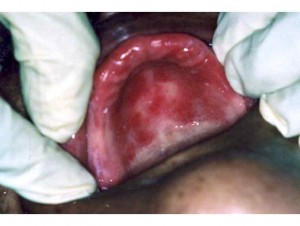
Denture-related candidiasis © IARC
Denture-related candidiasis is the most common lesion in the mouth and is usually Candida albicans infection. It generally affects the area covered by the upper denture and the lesion looks slightly granular (grainy) or irregularly eroded with reddish mucosa. A poorly fitted denture can act as a nutrient reservoir for fungal growth. However a well-fitted denture can also lead to candidiasis as the stability and peripheral seal of the upper denture allow fungus to flourish in absence of salivary flow and it seldom cause any discomfort. Furthermore the fungus can infect and reinfect the surrounding soft tissues in the mouth.
Treatment: Dentures should be kept clean and soaked frequently in antifungal agents, germicides or chlorhexidine. Affected tissues should be treated with topical antifungal.
2)Â Â Â Â Â Denture stomatitis (denture sore mouth / thrush)
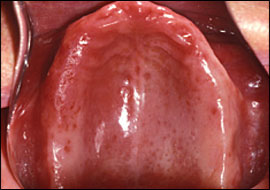
Denture Stomatitis © AAFP.org
The true etiology of the generalized inflammation of the mucous lining in the mouth associated with denture wearing is unknown. It may be due to contact hypersensitivity with the denture material, bacterial, candidial, medication use or systemic disease. Denture stomatitis worsens in those who wear dentures for a long period of time and do not remove their denture at night or those who are negligent in denture hygiene. The mucosa beneath the denture will appear swollen, red with or without whitish spots due to accumulation of Candida albicans or food remnants. The lesion rarely occurs under lower dentures as the negative pressure under the upper denture excludes saliva, enabling yeast to reproduce undisturbed. Furthermore the closer adaptation of the upper denture brings larger number of yeast on the denture surface into mucosa contact.
Treatment: Improve the denture fit and practice good oral hygiene. If it is a Candida albicans infection, the lesion should be treated with antifungal agents like nystatin or clotrimazole.
3)Â Â Â Â Â Traumatic ulcers (denture sore spots)
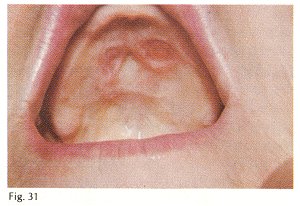
Traumatic ulcer © Grieg Roberts DDS
Unstable or unretentive dentures can lead to tissue irritation or ulceration due to excessive movement of denture. The ulcers can be caused by overextended denture, bone spicules (small pointed structures) under the denture or by food trapped between the mucosa and the denture. Lesions would appear small, painful, irregularly shaped covered by necrotic (dead tissue) membrane and surrounded by an inflammation halo.
Treatment: Treat underlying cause and the lesion will heal promptly.
Continue to part 2.
![Reblog this post [with Zemanta]](http://img.zemanta.com/reblog_e.png?x-id=a7041068-6f3c-470b-86fe-609a07467766)
Pingback: Denture-related problems affecting the mouth Part2 | Intelligent Dental
Pingback: How to care for your dentures | Intelligent Dental
Pingback: Dentures adhesive: Do you need them? | Intelligent Dental
Pingback: Everything you need to know about denture | Intelligent Dental
Pingback: Chronic Adult Periodontitis: Treatment and Prevention | Intelligent Dental
Pingback: Top 10 foods or drinks that strengthen tooth enamel naturally | Intelligent Dental
Pingback: Permanent Dentures and Permanent Dentures Cost |