continuation of part 1
4)Â Â Â Â Â Epulis fissuratum (denture fibrous hyperplasia)

Epulis fissuratum © 2008 Elsevier, Inc.
Commonly seen in those with poor fitting denture for a long period of time, the lesion may be due to the sharp denture margins or overextended flanges leading to chronic irritation of the soft tissues. It can appear as a single or multiple fold of tissue that grown in excess around the mucobuccal groove, which is the area where the gums meet the inner cheek. The tissue‘s mobility and continued growth can cause problems in maintaining denture retention. Painful ulceration is common in the base of the fold.
Treatment: Surgical excision of lesion and new denture construction.
5)Â Â Â Â Â Papillary hyperplasia of palate
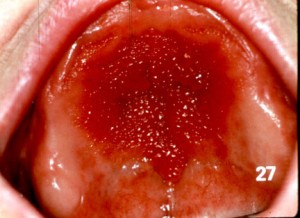
Papillary Hyperplasia © Brain Stoute DDS
This can be seen as a variety of denture stomatitis occurring in those who have been wearing poor fitted dentures for many years. However similar lesions can be seen in edentulous (teethless) individuals with high-arch palate. Multiple fusing small swollen, reddish elevations measuring around 1 to 2mm or more in diameter can be seen on the palate. The elevations can merge together and it can affect part or all of the hard palate forming a cauliflower-like appearance. There is no cause for alarm if this lesion is discovered for it is benign and asymptomatic despite looking like a cancerous growth.
Treatment: Be rest assured that this lesion is benign though it is best to confirmed it with your dentist. The lesion has to be removed before a new denture construction could be done.
6)Â Â Â Â Â Atrophy of maxillary alveolar ridge
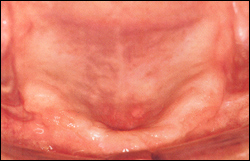
Atrophy of maxillary alveolar ridge
The alveolar ridge (a ridge that forms the borders of the upper and lower jaws and contains the sockets of the teeth) wasting away may be caused by excessive occlusal trauma due to poor fitting denture. The alveolus (the tissue covering the alveolar ridge) looks flabby and red and epulis fissuratum may coexist with the lesion.
Treatment: Surgical correction of the ridge.
Dentures have to be kept clean for they directly sit next to your teeth and soft tissues. Plaque, calculi and food debris can collect on your dentures like natural teeth and can cause irritation, inflammation, infection or bad breath. Gum inflammation or sore gums is especially higher in partial denture wearers as there is more plaque formation around the supporting teeth. Â Be forewarned that self repair, reline or adjustments can harm your denture or soft tissues in your mouth and self diagnosing can be dangerous without the proper knowledge. Therefore it is advised to occasionally service or readjust your denture at your dentist for there can be normal changes in your supporting bone and tissues (increased tooth mobility and accelerating bone loss).
![Reblog this post [with Zemanta]](http://img.zemanta.com/reblog_e.png?x-id=dfa51521-cf22-4aec-b37a-838817b2518c)
Pingback: Denture-related problems affecting the mouth Part1 | Intelligent Dental
Pingback: Everything you need to know about denture | Intelligent Dental